
News
Kunststoff
Unternehmen
INNOTEQ 2023: Nachhaltige Swissness für die MEM-Industrie


Selecting the appropriate cell culture flask is a critical step for maintaining healthy adherent cell cultures and achieving reproducible experimental results. The right flask supports cell attachment, growth, and gas exchange, while reducing contamination risk and workflow variability.
This guide outlines the key factors to consider when choosing cell culture flasks for adherent cell lines commonly used in research, biopharmaceutical development, and cell-based assays.
1. Surface Treatment: The Foundation of Adherent Cell Growth
Adherent cells require a surface that promotes attachment and spreading. Most cell culture flasks designed for adherent culture are TC-treated to introduce hydrophilic functional groups on the polystyrene surface.
Choose TC-treated flasks when working with:
HEK293
CHO (adherent strains)
Vero, MDCK, BHK
MSCs and fibroblasts
Primary adherent cells
Non-treated flasks are more suitable for suspension cultures or bacterial applications and should be avoided for adherent mammalian cells.
2. Flask Size and Growth Area
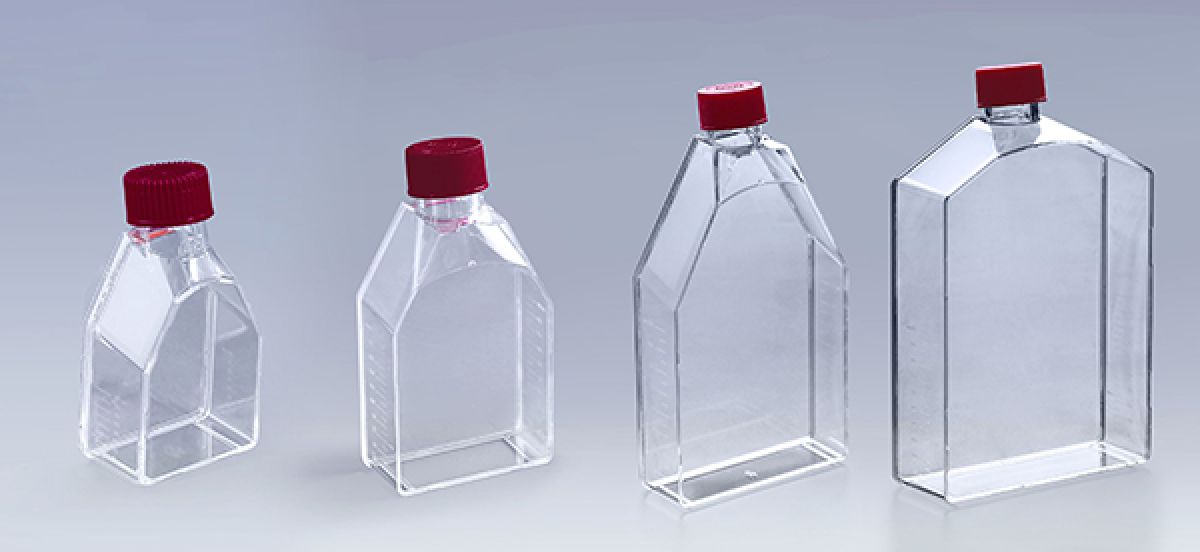
Cell culture flasks are available in multiple formats, typically designated by surface area:
T25 – small-scale maintenance and early experiments
T75 – routine culture, transfection, and screening
T175 / T225 – expansion, seed preparation, and scale-up
When selecting size, consider:
expected cell density
frequency of passaging
downstream application (transfection, harvest, scale-up)
Choosing an appropriately sized flask helps avoid over-confluence and ensures consistent growth conditions.
3. Cap Type and Gas Exchange
Gas exchange is essential for maintaining pH and oxygen levels in cell cultures.
Common cap options include:
Vent caps (filter caps): allow continuous gas exchange while maintaining sterility
Plug seal caps: require loosening during incubation to enable gas exchange
For routine adherent culture, vented caps provide greater convenience and reduce handling steps, especially in high-throughput or multi-flask workflows.
4. Material Quality and Optical Clarity
Most cell culture flasks are manufactured from polystyrene (PS), offering:
excellent optical clarity for microscopic observation
compatibility with TC surface treatment
chemical stability with standard culture media
High-quality flasks should be:
free of DNase, RNase, and endotoxins
sterilized by validated methods (gamma irradiation or equivalent)
manufactured under controlled cleanroom conditions
Material consistency directly impacts cell attachment and experimental reproducibility.
5. Sterility and Quality Assurance
For adherent cell lines, sterility is non-negotiable. Choose flasks that:
are individually or cleanly packaged
include sterility assurance information
comply with laboratory or GMP-adjacent requirements
Reliable sterility minimizes contamination risks, particularly in long-term culture or sensitive workflows.
6. Workflow Compatibility and Scale-Up
Consider how the flask fits into your broader culture workflow:
compatibility with standard incubators
ease of handling during feeding and passaging
suitability as a seed vessel for multilayer systems or bioreactors
Using consistent flask formats across experiments simplifies scale-up and improves data continuity.
Conclusion
Choosing the right cell culture flask is essential for successful adherent cell culture. By evaluating surface treatment, flask size, cap design, material quality, and sterility standards, researchers can create a stable and reproducible environment for adherent cell lines.
A well-selected flask not only supports healthy cell growth but also lays the foundation for reliable downstream experiments and process development.