

News
Kunststoff
Unternehmen
INNOTEQ 2023: Nachhaltige Swissness für die MEM-Industrie



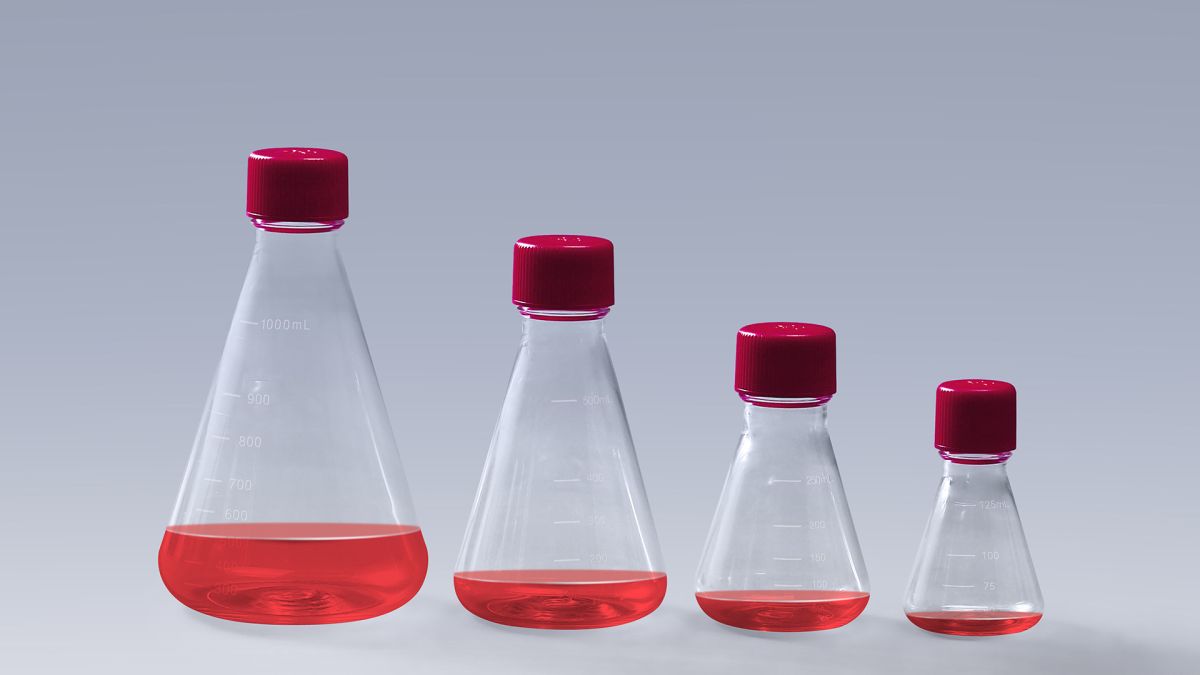
Suspension cell culture plays a critical role in microbiology, biotechnology, and biopharmaceutical research. From bacteria and yeast fermentation to plant and animal cell expansion, laboratories rely on culture vessels that provide efficient mixing, reliable gas exchange, and stable growth conditions. Among the most widely used tools, the Erlenmeyer Shake Flask remains a fundamental solution for suspension-based cultivation and early-stage process development.
1.Why Suspension Cell Culture Requires the Right Flask Design
Unlike adherent cell culture, suspension systems depend heavily on continuous agitation to keep cells evenly distributed in the medium. Insufficient mixing can lead to nutrient gradients, oxygen limitations, or cell sedimentation, all of which negatively affect growth and reproducibility.
The classic Erlenmeyer Flask, with its conical body and narrow neck, was originally designed to facilitate swirling and mixing without spillage. When adapted for use on orbital shakers, this design becomes especially effective for suspension cell culture, offering both mechanical stability and efficient fluid dynamics.
2.Key Advantages of Erlenmeyer Shake Flask in Suspension Culture
Efficient Mixing and Homogeneous Conditions
The conical shape of an Erlenmeyer Shake Flask promotes circular liquid movement during shaking. This helps maintain cells in suspension while ensuring uniform distribution of nutrients, dissolved gases, and metabolic byproducts throughout the culture medium.
Compared to straight-walled bottles, Erlenmeyer flasks reduce dead zones and improve mixing efficiency, even at relatively low shaking speeds—an important factor for shear-sensitive animal and plant cells.
Reliable Gas Exchange with Vent Cap Design
Gas exchange is a critical parameter in suspension culture, particularly for aerobic microorganisms and high-density cell systems. Modern Erlenmeyer Shake Flasks are commonly equipped with vent caps featuring hydrophobic PTFE membranes, which allow oxygen and carbon dioxide exchange while preventing microbial contamination.
This breathable cap design enables cells to maintain optimal metabolic activity without frequent manual intervention, making shake flasks suitable for long-term cultures and screening studies.
Biocompatible Materials for Sensitive Cells
Single-use Erlenmeyer Shake Flasks manufactured from USP Class VI PETG or PC materials offer excellent biocompatibility and chemical resistance. These materials are widely accepted in life science laboratories and biopharma environments due to their low extractables, transparency, and mechanical strength.
Compared with traditional glass Erlenmeyer flasks, plastic shake flasks reduce the risk of breakage, improve operator safety, and simplify handling in high-throughput laboratory settings.
3.Typical Applications of Erlenmeyer Shake Flask
Erlenmeyer Shake Flasks are versatile tools used across multiple disciplines, including:
Bacteria and yeast cultivation for protein expression, plasmid amplification, and fermentation studies
Fungal cultures for enzyme and metabolite production
Plant cell suspension culture in secondary metabolite research
Animal cell expansion during early-stage bioprocess development
Culture medium preparation, mixing, and short-term storage
In many workflows, shake flask experiments serve as a bridge between small-scale screening and larger bioreactor studies, providing valuable data on growth kinetics and process parameters.
4.Practical Considerations for Suspension Cell Culture
To achieve consistent and reproducible results with an Erlenmeyer Shake Flask, several practical factors should be considered:
Fill volume: Typically limited to 20–30% of the nominal flask volume to ensure adequate oxygen transfer
Shaking speed and orbit: Adjusted based on cell type, viscosity of the medium, and flask size
Cap selection: Vent caps for active cultures; seal caps for media preparation or storage
Sterility assurance: Single-use, pre-sterilized flasks help minimize contamination risks and simplify workflows
Attention to these parameters allows researchers to maximize the performance of Erlenmeyer flask while maintaining cell viability and productivity.
5.Erlenmeyer Shake Flasks in Modern Laboratories
Despite the increasing adoption of advanced bioreactors, the Erlenmeyer Shake Flask remains indispensable in modern laboratories. Its simplicity, cost-effectiveness, and flexibility make it an ideal choice for routine suspension culture, method development, and early-stage research.
For laboratories seeking a balance between performance and practicality, Erlenmeyer flask continue to offer a reliable platform for cultivating a wide range of cell types under controlled yet accessible conditions.
Conclusion
The Erlenmeyer Shake Flask is more than a basic laboratory vessel—it is a proven tool for suspension cell culture that supports efficient mixing, effective gas exchange, and reproducible results. By combining classic Erlenmeyer flask geometry with modern materials and vented cap technology, shake flasks remain a cornerstone of cell culture workflows across research, biotechnology, and biopharmaceutical applications.