

News
Kunststoff
Unternehmen
INNOTEQ 2023: Nachhaltige Swissness für die MEM-Industrie



Cell therapy has become one of the most promising fields in modern biotechnology, offering new possibilities for regenerative medicine, immunotherapy, and personalized medicine. From stem cell research to CAR-T cell development, successful cell therapy manufacturing relies heavily on stable, efficient, and contamination-free cell expansion processes.
A critical component in laboratory-scale cell expansion is the cell culture flask, which provides a controlled environment for adherent cell culture, cell growth, and preparation before transitioning to larger-scale production systems.
High-quality sterile cell culture flasks play an essential role in maintaining cell viability, supporting consistent cell attachment, and ensuring reliable results throughout the cell therapy workflow.
The Importance of Sterile Cell Culture Flasks in Cell Therapy
Cell therapy applications require strict control over every stage of cell processing. Unlike traditional research applications, cell therapy manufacturing demands higher standards for sterility, traceability, and process consistency.
A reliable cell culture flask for cell therapy should provide:
1. Superior Cell Attachment Performance
Many therapeutic cell types, including mesenchymal stem cells (MSCs), fibroblasts, and other adherent cells, require optimized surface treatment for efficient attachment and proliferation.
High-quality tissue culture flasks are typically treated with advanced surface technologies to enhance:
Cell adhesion
Uniform cell spreading
High-density cell growth
Improved cell recovery after harvesting
This helps researchers achieve consistent expansion results while reducing variations between batches.
2. Sterile and Contamination-Controlled Manufacturing
Sterility is one of the most important requirements for cell therapy applications. Any contamination during cell expansion can compromise research results and affect downstream manufacturing processes.
Professional sterile cell culture flasks are manufactured under controlled environments and commonly feature:
Gamma irradiation sterilization
Low endotoxin levels
DNase/RNase-free materials
Individual sterile packaging
Lot-to-lot consistency
These features support safer cell culture operations in research laboratories and GMP-related environments.
Choosing the Right Cell Culture Flask for Cell Expansion
Different stages of cell therapy development require different cell culture formats. Selecting the appropriate flask size helps optimize cell growth efficiency and laboratory workflow.
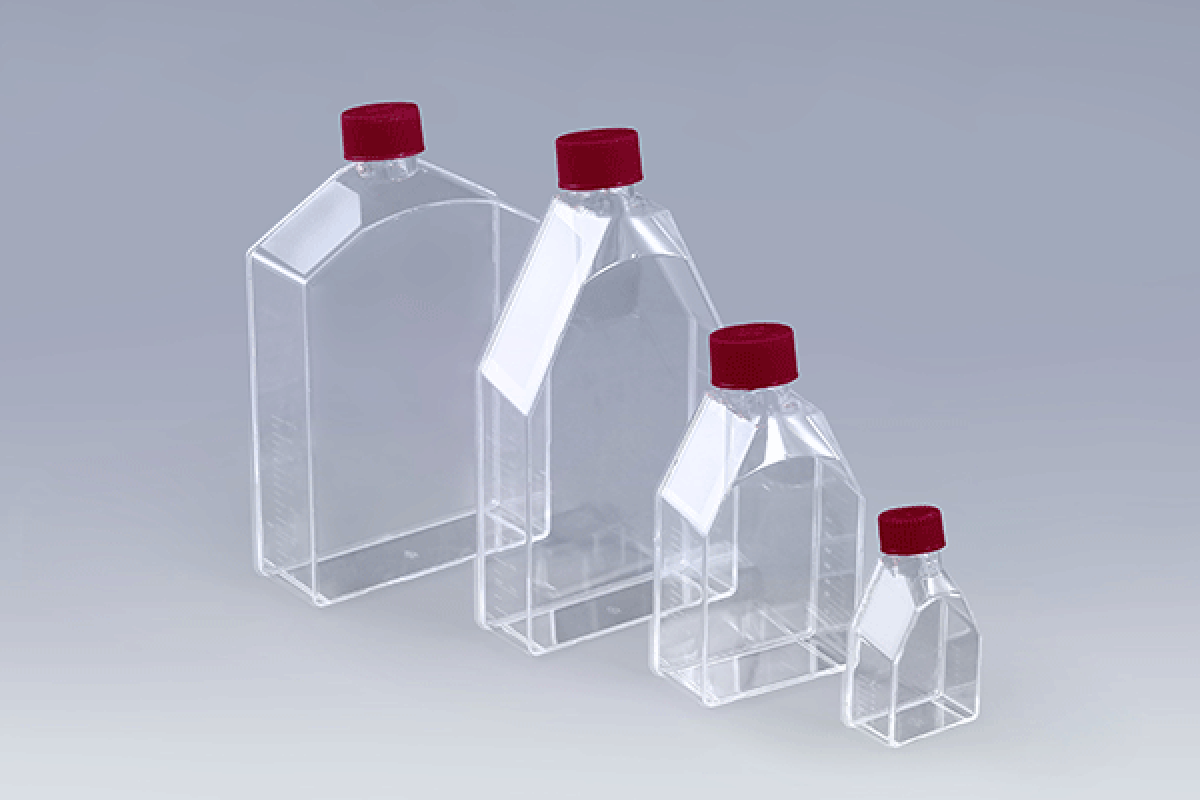
T25 Cell Culture Flask
The T25 flask is commonly used for:
Initial cell recovery
Small-scale cell culture
Cell line maintenance
Early-stage research applications
It provides a convenient format for routine laboratory operations.
T75 Cell Culture Flask
The T75 cell culture flask is one of the most widely used formats for cell expansion.
It is suitable for:
Stem cell expansion
Primary cell culture
Cell banking preparation
Research-scale production
The larger growth surface area allows researchers to obtain higher cell yields while maintaining manageable handling procedures.
T175/T225 Cell Culture Flask
For applications requiring increased cell numbers, the T175 cell culture flask provides a larger surface area for efficient expansion.
It is often used in:
Large-scale laboratory cell expansion
Pre-production cell preparation
Biotechnology research workflows
By combining multiple T175 flasks, laboratories can achieve scalable cell culture processes before moving into closed-system or bioreactor-based production.
Key Features of High-Quality Cell Culture Flasks
Selecting a reliable cell culture flask manufacturer is essential for achieving reproducible cell culture performance.
Premium cell culture flasks typically include:
Medical-Grade Polystyrene Material
High-quality raw materials provide excellent optical clarity and mechanical strength, allowing researchers to easily observe cell morphology under microscopy.
Advanced Surface Treatment
Optimized tissue culture treatment improves cell attachment and supports consistent growth of sensitive cell types.
Ergonomic Design
Features such as:
Wide neck design
Easy-access corners
Secure caps
Uniform thickness
help improve laboratory efficiency and reduce handling risks.
Compatibility with Cell Therapy Workflows
Modern cell culture consumables should be compatible with:
Cell expansion protocols
Serum-containing and serum-free media
Stem cell culture applications
GMP manufacturing environments
From Research Scale to Clinical Manufacturing
Cell therapy development requires a smooth transition from laboratory research to clinical production. While cell culture flasks are mainly used during research and early development stages, they remain an important tool for optimizing culture conditions before scaling up.
A typical workflow may include:
Cell Isolation → Cell Expansion in Cell Culture Flasks → Process Optimization → Scale-Up Production → Clinical Manufacturing
During this process, consistent performance of cell culture vessels helps researchers establish reliable expansion protocols.
For organizations developing advanced therapies, partnering with an experienced cell culture flask supplier ensures access to dependable products that meet research and production requirements.
Why Choose a Professional Cell Culture Flask Manufacturer?
A trusted manufacturer should provide not only high-quality products but also comprehensive quality assurance.
Key considerations include:
ISO-certified manufacturing systems
Controlled cleanroom production
Strict quality inspection
Sterility validation
Product traceability
Technical support
For biotechnology companies, pharmaceutical researchers, and cell therapy developers, reliable sterile cell culture solutions are essential for maintaining cell quality and improving development efficiency.
Conclusion
As cell therapy continues to advance, the demand for reliable and scalable cell expansion solutions is increasing. Sterile cell culture flasks provide a fundamental platform for supporting adherent cell culture, stem cell expansion, and early-stage cell therapy development.
By selecting high-performance cell culture flasks from an experienced manufacturer, researchers can achieve better cell growth consistency, improved process control, and greater confidence throughout their cell therapy journey.